· Dinesh Gajjar · Insights · 5 min read
We Needed a Better Way to Run Content. So We Built One.
We were running content across multiple companies, products, and platforms — and the tools we tried still left gaps. So we built a Content Operating System: one idea in, every channel out.
Like most product engineering companies, we do not just build software for our clients — we also run our own set of brands, products, and campaigns. And somewhere along the way, our content operations started to buckle under their own weight.
We were managing multiple companies. Each had its own products. Each product had its own campaigns. And every campaign spilled across LinkedIn, Instagram, Facebook, our websites, and more. The same idea had to be rewritten for each platform, reviewed by the right people, approved, and finally scheduled — and all of that was happening across scattered documents, chat threads, and calendars that never quite agreed with each other.
So we did what most teams do first: we went looking for a tool.
The Search That Did Not End Well
There are genuinely good platforms out there. But every time we got close, one or two pieces were missing.
Some handled scheduling beautifully but had no real concept of our structure — an organization that oversees many companies, each with distinct products, campaigns, and social accounts. Others could manage brands but treated every social post as a separate, disconnected asset, so a single idea meant re-doing the same work five times over. Almost none of them gave us a flow so clear that anyone on the team — not just the power user — could look at it and immediately understand what to do next.
And then there was the cost. Even when a platform came close to meeting our requirements — say, 80% of the way there — the pricing to actually get it working the way we wanted climbed well beyond the budget we had in mind. The closer a tool got to the full picture, the more it asked for, especially once we added enough seats and companies to match a real multi-brand operation. We were not willing to keep paying more and more for something that still left gaps.
We wanted something obvious. One idea in. Every channel out. A straight line a layperson could follow from “here is a thought” to “it is approved and on the calendar.” That tool, exactly as we needed it and at a cost that made sense, did not exist.
So We Built It
We built a platform for ourselves — a Content Operating System. Not a scheduler, not a folder of drafts, but the connective tissue between an idea and everything it eventually becomes.
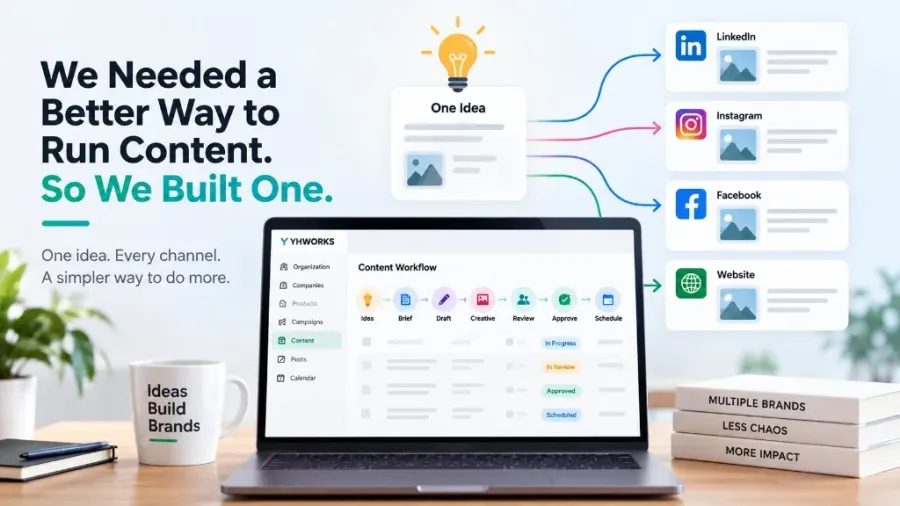
The core insight was simple. You should not manage social content as separate pieces. You should start with one content idea — the brief, the source message, the objective, the assets — and let that single idea branch into platform-specific posts. LinkedIn gets the version it needs. Instagram gets its own. So do Facebook and the website. But they all stay connected back to the original thought, so nothing drifts and nothing gets lost.
Around that idea, we built the structure our organization actually has: Organization → Companies → Products → Campaigns → Content → Posts. Everything has a place. And on top of it sits a workflow anyone can read at a glance — Idea, Brief, Draft, Creative, Review, Approve, Schedule — where every piece of content always has a clear status, a clear owner, and a clear next step.
We Did Not Reinvent Everything
An honest note on how we got here quickly: we did not build every brick from scratch. We took capable components that already exist, brought them together around our requirements, and shaped them into a single, coherent, multi-tenant platform. The engineering value was not in reinventing the wheel — it was in the integration, the structure, and the clarity of the flow. That is what turned a pile of good parts into something that actually runs our content operations end to end — and it is also what let us do it without the runaway costs we kept running into elsewhere.
Where It Stands Today
This is a recent build, and it is already doing real work. We are using it against live users right now, and we are fine-tuning the experience as we go — watching how real people move through it and sharpening the parts that matter.
And that is the part worth sharing. We built this to solve our own problem, but the problem is not ours alone. Any organization or agency juggling several companies, dozens of products, and content scattered across platforms feels exactly this friction — and the same budget frustration. So we built it to be ready for others, too.
If This Sounds Like Your Team
If you are managing content across multiple companies, brands, and channels — and you are tired of doing the same work five times, losing track of it, and paying more than you planned for the privilege — we would genuinely like to show you what we built.
Book a consultation with one of our founders, or write to us at tech@yhworks.com — you can also call us on +91-7977497746 or +91-9324265426. We would be glad to walk you through it and show you how it could fit your organization. We built it because we needed it. And we would be glad to help you run your content the same way.